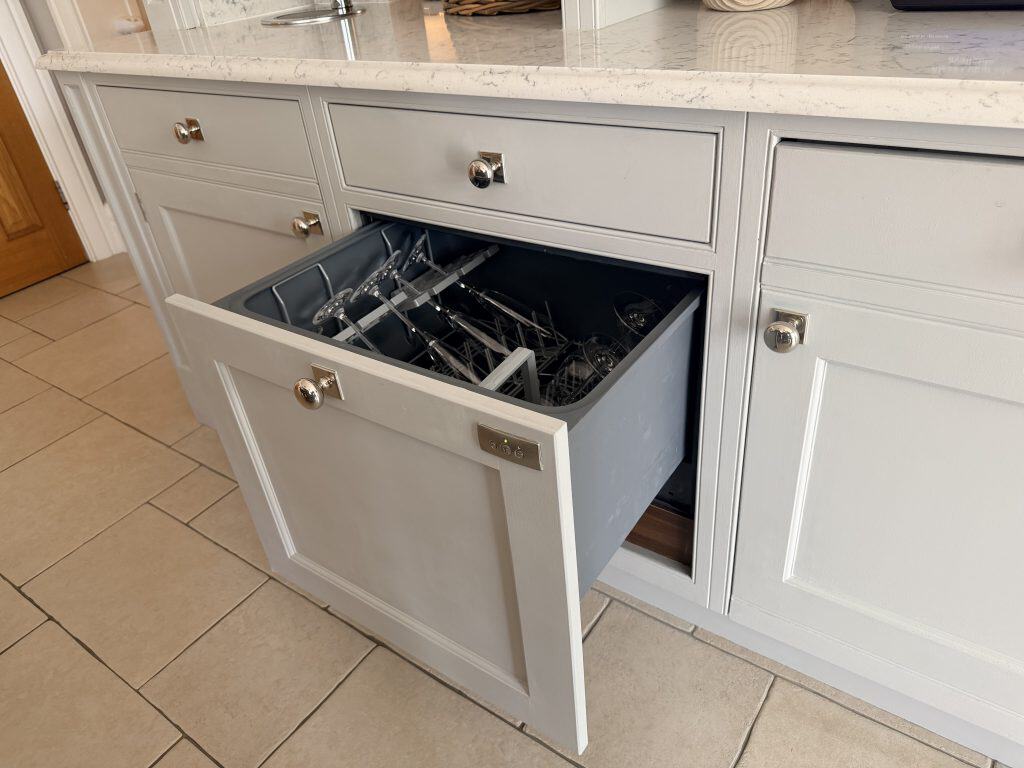
Why Architects Keep Specifying the Fisher & Paykel DishDrawer in Island Kitchens
Ask an architect why they’ve specified a Fisher & Paykel DishDrawer instead of a standard dishwasher on an island run. The answer is rarely about wash performance. It’s about what happens when the appliance opens while people are standing around the island. A full-height door swings into the walkway and stays there until it’s loaded. Two drawers don’t. Each one opens and closes like any other cabinet drawer, and neither blocks the route round the island.
The clearance problem
On an island, there’s usually no wall to duck behind while a door is open. Traffic runs on every side, and seating overhangs eat into the working clearance architects are trying to protect — typically a minimum of 1,000–1,200mm around a working island, more where there’s seating. A dishwasher door swinging open reduces that clearance by roughly its own depth, right at the point where people are moving most. It’s a small detail on a floor plan. It’s the kind of detail that shows up as a complaint six months after handover.
What two drawers solve
- No swing door blocking the walkway. Each drawer opens and closes independently, like the rest of the cabinetry.
- Loads can be split — glassware in one drawer, pans in the other — rather than waiting for a single full cycle.
- Panel-ready fronts sit flush with island cabinetry, keeping sightlines clean on a run that’s visible from three sides.
- One drawer can run a cycle while the other’s still being loaded or unloaded.
In practice
One recent island install made the case plainly. A full-size dishwasher handled the general run in the main kitchen. A Fisher & Paykel DishDrawer went into the island itself, right beside the dining table, dedicated entirely to glassware. Champagne flutes and tall stemmed wine glasses don’t sit well in a standard dishwasher’s upper rack. Loaded upright into the DishDrawer, they came out secure — no swing door clattering open next to a table people were sitting at while it ran.
What our product specialists tell architects
“Normal dishwashers don’t cope well with tall stemmed glasses,” is the line our team gives clients weighing up a second drawer. “The Fisher & Paykel DishDrawer is perfect for them.” It’s just as suited to the oversized pot or platter that won’t sit in a standard rack — that’s when a kitchen needs a second wash zone, not a second full-size machine.
Where it doesn’t suit
It isn’t the right call for every kitchen. Each drawer’s capacity is smaller than a full-size dishwasher tub, so a genuinely large family load can mean running both drawers rather than one cycle. That’s not always the more efficient option on water or energy. Two units cost more upfront than a single full-size dishwasher, and need two sets of plumbing and drainage connections rather than one. It’s a decision worth making with the kitchen designer early — before the cabinetry’s ordered, not after.
A note on availability
The DishDrawer isn’t currently part of our Ruislip showroom display. It’s a model our product specialists specify and source regularly for trade and development clients. If you’re specifying one for a project, get in touch before the kitchen’s fitted — we can talk through fit, installation requirements and lead times.
Get in touch early
If you’re specifying kitchens for developer or private clients across Kensington, Notting Hill, Holland Park or Chelsea, involve our trade team early — before the cabinetry’s ordered, not after. Read more on getting integrated appliances right the first time, or see the Fisher & Paykel DishDrawer model we source most often