
Miele Tumble Dryers — Vented vs Condenser vs Heat Pump Explained
Search for a Miele vented tumble dryer and you’ll come away empty-handed. That’s not a stock gap. Miele stopped making vented dryers five years ago, and condenser models followed about three years ago. Every dryer in their current range runs on heat pump technology, from the entry-level T1 machines up. So if you’re confused about where the vented and condenser models went, here’s the short version: Miele chose to go heat-pump-only. For most homes, that’s the right call anyway — especially flats and conversions with no external wall to vent through.
A customer who took some convincing
A woman came in a few months back set on a vented dryer. Cheaper to buy, and she’d heard heat pump dryers took forever to dry a load. Fair concern — heat pump cycles do run longer than vented ones. We talked her through the running costs and sold her a new Miele heat pump dryer instead. She rang a few months later to say thank you: the extra she’d paid over a vented model, she’d already saved back in energy costs. Her clothes were coming out better cared for too — colours held better, and she barely needed to iron. She’s converted.
What actually separates the three types
Vented dryers heat air, pass it through the wet washing, then blow the moisture out through a hose to a window or an external wall. They’re the cheapest to buy. They’re also the fastest to dry a load. But you need somewhere for that air to go, and they cost the most to run.
Condenser dryers don’t need a vent. The moisture condenses inside the machine into a water container instead. Empty it yourself, or plumb it in and it drains away on its own. That flexibility is the appeal. But older condenser models ran hot and used more power than people expect — that’s usually where the “takes forever and comes out damp” complaint comes from.
Heat pump dryers are vent-free too. But instead of generating heat and throwing it away, they recycle the warm air through a heat exchanger. That’s why every Miele dryer we stock carries an A+++ rating. Lower operating temperatures mean gentler treatment for fabric — that’s where the fading and creasing improvement comes from. They’re also the cheapest of the three to run, by some distance. The trade-off: a longer cycle, and a higher price upfront. That’s usually the sticking point, before anyone’s worked out the running costs. As the team here puts it: you recoup the extra upfront cost quickly in energy savings.
The one thing worth checking before you buy
Nobody wants to empty a water container after every wash. Most heat pump and condenser dryers can be plumbed in instead, so the water just drains away. But that only works if there’s plumbing access where the dryer’s going. Check that before you commit to a spot in the kitchen or utility cupboard.
Why this comes up more in West London than most places
We recently supplied a West London apartment block with the washer and dryer stacked in a utility cupboard, on an internal wall backing onto the kitchen. No external wall meant venting was never an option. There was plumbing access nearby, though, so we set the dryer up to drain on its own — no daily emptying required. We see this layout constantly across flats and conversions locally. It’s exactly the kind of job where ‘just get a vented one’ was never actually on the table, whatever the search results suggest.
What we actually stock
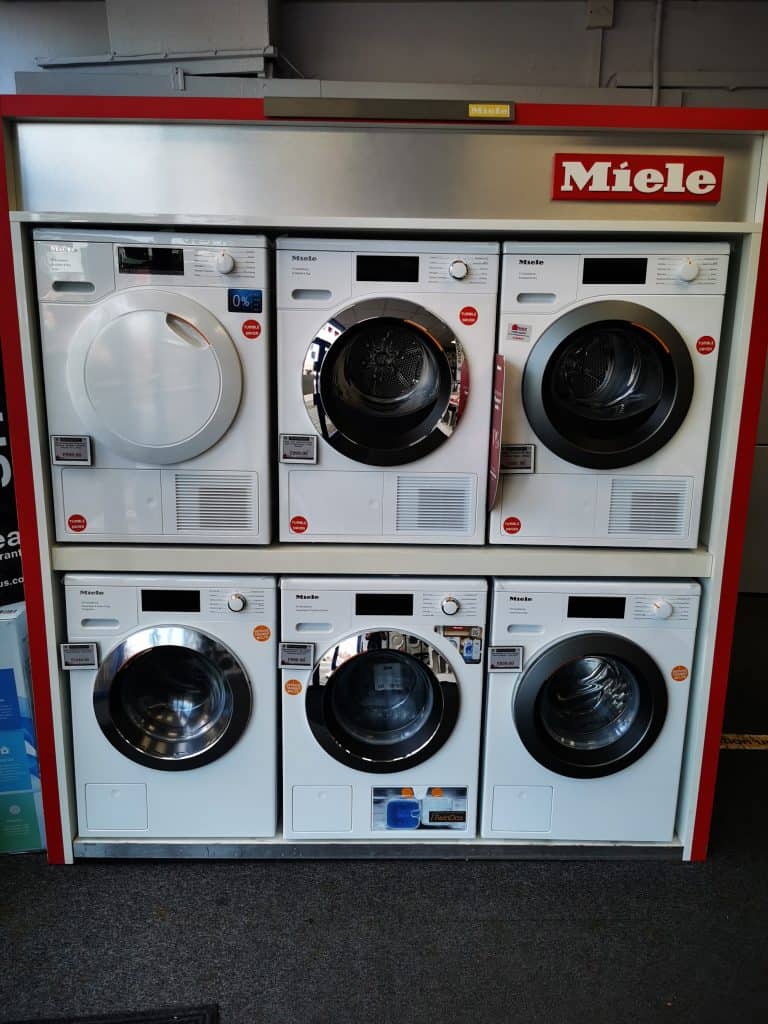
We’re a Miele stockist. Every dryer we hold is heat pump — not because Miele leaves us no choice, but because that’s what customers want once they understand what they’re buying. Browse the Miele dryers we currently have in stock online. Or come and see them running side by side in the showroom — that tends to settle the vented-versus-heat-pump question faster than any spec sheet.
Weighing up what a new dryer install actually involves — venting, plumbing, what’s included and what isn’t? Our recent piece on appliance installation covers it in full. Not sure which type suits your home? Come in and talk it through with the team before you decide. It’s a five-minute conversation that can save you a wasted purchase.